Reports lose context
Information moves through a hierarchy and each handover removes location, evidence or operational detail.
Introducing RAMS AI Vision — Intelligent Warehouse Perception
A 3D model shows you the building. A Digital Twin shows you the operation — every asset in its place, every event in context, every change kept as history you can go back to.
Model Anything. Connect Everything. Operate In Context.












The problem today
Critical facility knowledge remains fragmented across drawings, spreadsheets, reports, presentations and isolated systems.
Information moves through a hierarchy and each handover removes location, evidence or operational detail.
Management must visit or depend on summaries to understand what is happening at a distant site.
Layouts and physical modifications are often reviewed without a persistent operational model.
Assets, sensors, inspections, MHE, inventory and maintenance data lack a shared physical context.
Product overview
RAMS Digital Twin creates a persistent digital representation of the facility and everything operating inside it.
How it works
A simple adoption workflow creates value early and adds intelligence progressively.
Draw inside the platform or reconstruct the existing facility from LiDAR scan files.
Model completeness
The RAMS 8D framework
A 3D model answers the first two. Everything after that is what makes it a twin.
Where is it?
Geometry, layout, dimensions, zones and the spatial relationships between everything in the building.
What is it?
Class, specification, make and the identity that follows the asset from installation to disposal.
How has it changed?
Every state the facility has been in, retained — so change is measurable rather than remembered.
What condition is it in?
Structural and operational state against the standard it was designed to, with the severity that follows.
How is it being used?
Occupancy, throughput, the traffic that passes it and the equipment that works it.
What if we change it?
Reach, clearance, flow and capacity, answered against the model while the change is still a proposal.
What is happening now?
The current reading, in place — impact, tilt, load, movement and the events arriving this second.
What does it mean next?
The seven layers above read together: a pattern rather than an alert, and what to do before it repeats.
Product experience
The geometry is identical on both sides of this switch. What changes is whether anything is attached to it.
Nothing attached
A drawing of the building, and nothing else. It knows where things are. It does not know what they are, what they did, or what is happening to them now.
Outcomes / Business value
Direct visibility reduces dependence on layered reporting and keeps decisions connected to the operational truth.
Understand and reduce physical operational risk, with every event resolved to the place it happened.
Impacts per 1,000 MHE hoursUnderstand how people and assets produce work, and where the shift is actually being spent.
Travel distance per pickIdentify wasted time, movement, capacity and resources against the real building.
Storage and fleet utilisationSee what is actually happening across connected facilities, without waiting on a report.
Systems reconciled to the twinIntegrations
Bring enterprise systems, operational technology, edge intelligence and physical sensing into the same context.
Business systems
The twin gives records from the systems you already run a location, without replacing any of them.
RAMS hardware
Our own impact, tilt, load and vision hardware, commissioned against the model rather than a spreadsheet.
Client hardware
Sensors and controllers you already own keep their job and attach to an asset in the twin.
AI & edge
Vision and analytics at the edge and in the cloud — open at the sensor layer, intelligent at the edge.
Product proof
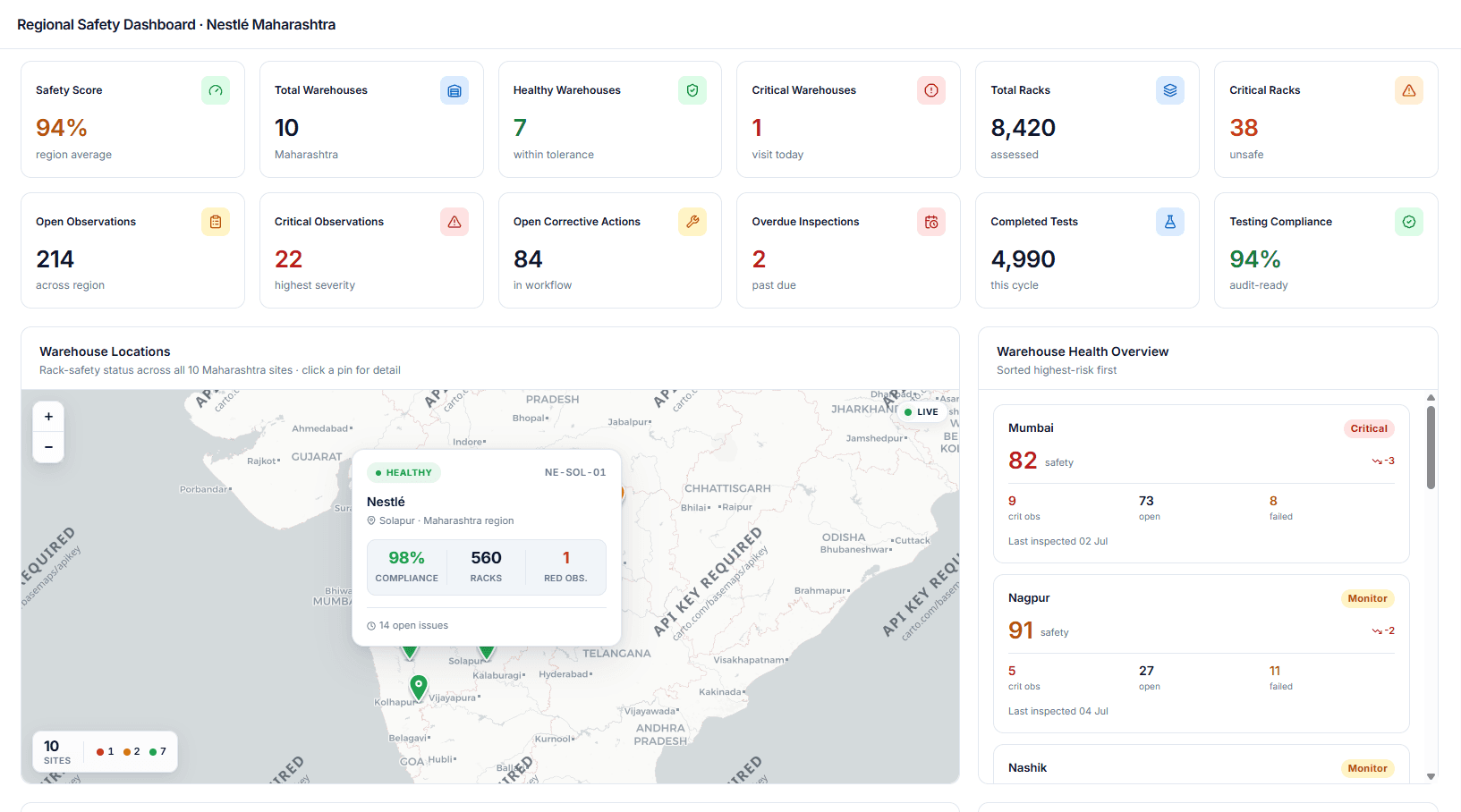
RAMS 2.0 demonstrates that sophisticated safety, productivity, inventory, maintenance and management applications can operate on the Digital Twin.
FAQ
No. The model is the starting point. RAMS Digital Twin adds asset identity, lifecycle history, simulation, live data, operational context, AI and applications on top of it.
Start the conversation
Create the Digital Twin. Tag the assets. Simulate change. Connect sensors and systems. Add applications. Build a persistent operating layer for the physical facility.